
Checking Criminal History in Ontario
Define the record before choosing an Ontario source. A police report describes an event handled by Ontario officers. A booking record follows custody in the county jail system. The court file shows what prosecutors filed and how the case ended. A California DOJ record review is a fingerprint-based copy of your own statewide summary, not an open public name search.
- Collect the name, incident date, report or case number, and the type of Ontario record sought.
- Use Ontario Police Records or GovQA for city-held police and public records; use BuyCrash for the separate traffic-report route.
- Check the San Bernardino County Sheriff inmate locator for current custody after an Ontario arrest.
- Search the Superior Court Court Access Portal and follow the court location listed on the case.
- Request your own statewide California history through DOJ record review and an approved Live Scan provider.
These sources should be read together when accuracy matters. The broader San Bernardino County criminal history overview explains how county and state repositories differ from Ontario records.
Ontario Records Bureau Operations
Ontario Police describes a Records Bureau that serves the public at the front desk and by telephone while also supporting sworn personnel. Its work includes report management, releases, data entry, vehicle records, missing-person information, court arrest packets, traffic citations, and questions from the public. The bureau reports 15 employees: one Police Records Manager, two Records Supervisors, four Senior Records Specialists, and eight Records Specialists.
This staffing detail shows why the bureau is more than a copy counter. Records personnel maintain data that moves among officers, dispatch, courts, and state law-enforcement systems. A public requester still receives only material that the law permits the department to disclose.
Ontario Police Department Records
Ontario Police Records handles crime reports, collision reports, stored or impounded vehicle releases, fingerprint services, registrants, ticket sign-offs, repossession receipts, and telephone questions. The front desk can direct callers to dispatch when a matter is operational rather than a record request. Public-record requests use GovQA, and traffic reports use BuyCrash. That division matters because neither link is a general criminal-history database.
The Ontario Police Records Bureau page lays out its services, hours, and fees. The official page is captured below for source context.
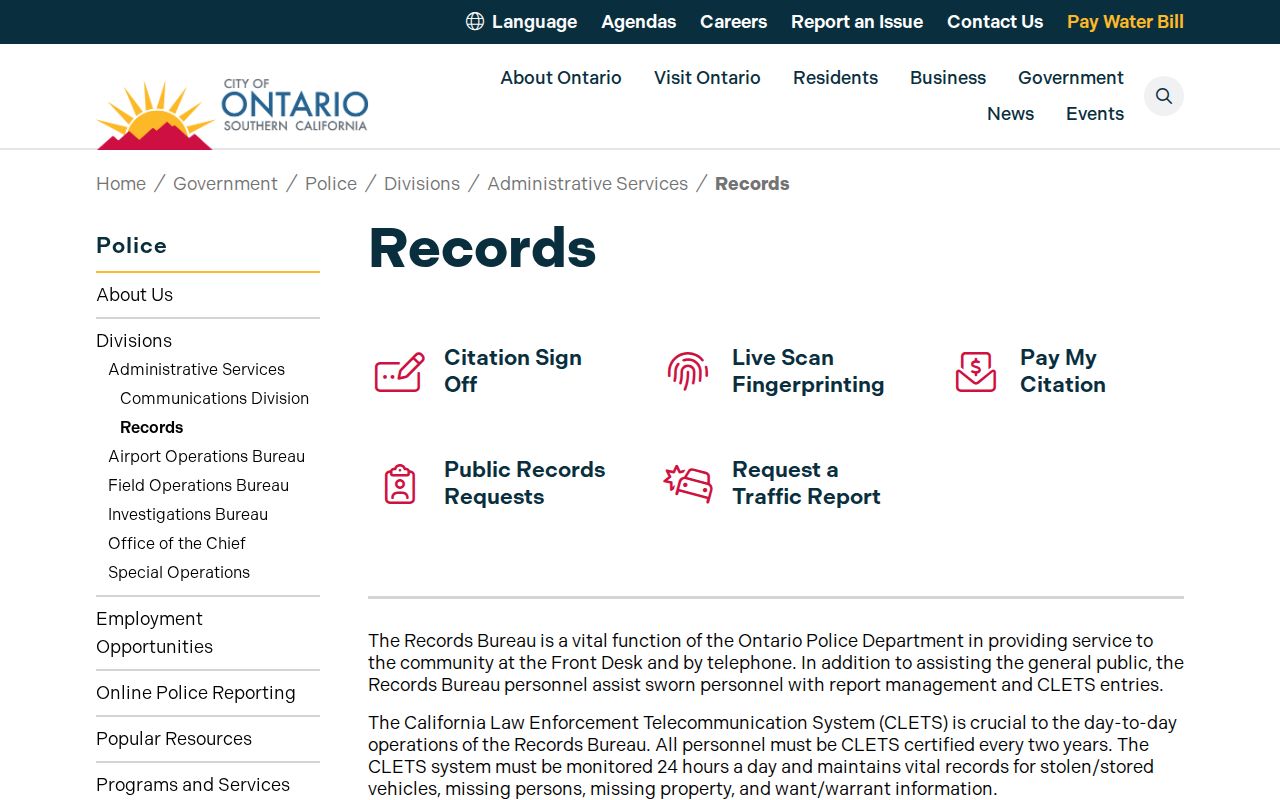
The bureau page is the best starting point for confirming the current counter rule before making a trip or paying for a service.
Ontario Records in CLETS and Tiburon
The bureau monitors the California Law Enforcement Telecommunications System, known as CLETS, 24 hours a day. CLETS is a restricted law-enforcement communications network, not a public web portal. Ontario uses it for operational entries that include stolen or stored vehicles, missing persons, missing property, and want or warrant information. A member of the public cannot search CLETS by entering a name.
Ontario staff also enter crime reports, traffic collisions, vehicle entries, missing-person records, court arrest packets, and traffic citations into Tiburon RMS, the department's records management system. RMS means the internal system used to organize agency records. A public copy request is reviewed through Ontario's release process even though the underlying entry lives in Tiburon.
- CLETS
- A restricted California law-enforcement telecommunications system monitored by authorized agencies.
- Tiburon RMS
- Ontario Police's internal records management system for reports and related entries.
- Court arrest packet
- Agency paperwork assembled to support court processing after an arrest.
Ontario Arrests and Bookings
An arrest made by Ontario Police creates a city police record first. If the person is booked into San Bernardino County custody, the current inmate record belongs to the Sheriff. West Valley Detention Center is a major county custody facility for the valley, but the inmate locator should determine current housing rather than an assumption based on where the arrest occurred.
Ontario's report may describe the alleged conduct and officer response. The booking entry documents custody. The Superior Court file then shows charges actually filed, hearings, pleas, and disposition. Those records can differ because prosecutors may change or decline charges. An arrest is not a conviction and should never be described as proof of guilt. The county arrest lookup resource provides more depth on custody and records-request routes.
Ontario GovQA Public Requests
Ontario routes public-record requests through GovQA. Use that channel for an identifiable city-held record when no narrower service applies. Describe the record, date range, department, and event with enough detail for staff to locate it. A concise request is easier to process than a demand for every record associated with a broad name.
GovQA does not bypass exemptions. Ontario may redact private information, protect an active investigation, or withhold a record when California law requires it. Traffic reports have a separate BuyCrash link, and county court or jail records must go to their county custodians. Watch the portal for requests for clarification and the city's response.
Municipal Court Records in Ontario
Ontario has no separate municipal criminal court. Ontario-area prosecutions move through the Superior Court of California, County of San Bernardino. Rancho Cucamonga District is geographically important to many West Valley matters, but charge and location determine the assigned court. Search the Court Access Portal first and follow the location on the case rather than assuming the nearest courthouse holds the file.
| Court system | Superior Court of California, County of San Bernardino |
|---|---|
| City court | No separate Ontario municipal criminal court |
| Lookup channel | Superior Court Court Access Portal |
| Possible West Valley location | Rancho Cucamonga District, subject to the location listed on the case |
| File contents | Filed charges, hearing dates, pleas, disposition, and sentence when entered |
The police report and court file are not interchangeable. Ontario Police records the incident; the court records the prosecution and judicial outcome.
Ontario Weekend Counter Limits
Ontario's front desk hours are Monday through Friday, 7 a.m. to 6 p.m. On Saturday and Sunday, it opens from 9 a.m. to noon for vehicle releases only. The bureau closes on federal holidays. Weekend access therefore does not mean a requester can arrive for a report copy, clearance letter, or fingerprint service.
Use the weekday window or the relevant online request channel for Ontario criminal records. For a vehicle release, confirm documentation and current requirements with the bureau before traveling. The narrow weekend service is easy to miss, and showing up for an unrelated record will not create an exception.
Where Ontario Records Go
Ontario Police creates and maintains the local agency record. When the district attorney files charges, the San Bernardino County Superior Court creates the criminal case file. Authorized arrest and disposition reporting can later update the California Department of Justice criminal-history repository. The systems connect, but each remains a separate official source.
Record flow: Ontario Police Department › San Bernardino County Superior Court › California Department of Justice
A newly written Ontario report may precede the case docket. The final court outcome may post later, and the state summary can depend on agency reporting. If records conflict, compare date of birth, case number, arrest date, and disposition, then ask the originating custodian about correction procedures.
Ontario Records Service Fees
Ontario publishes several counter-service fees effective July 1, 2025. These are fees for particular services, not the price of a broad public criminal background search. A Live Scan fee listed by Ontario is the city's rolling charge and may not include separate DOJ or other agency processing fees.
| Ontario service | Published fee |
|---|---|
| Fingerprint Live Scan | $17 |
| Fingerprint ink card | $8 |
| Violation citation sign-off copy | $22 |
| Clearance letter | $26 |
| Vehicle repossession receipt | $15 |
A clearance letter is a specific local service and should not be confused with a fingerprint-based California DOJ record review. Ask what the letter covers, bring the identification the bureau requires, and verify the current fee before visiting.
Note: Live Scan providers may charge separate rolling and government processing amounts based on the authorized transaction.
Ontario Warrant Records Are Restricted
Ontario Records maintains want and warrant information within CLETS, but the research did not identify a public Ontario warrant name-search site. CLETS access is limited to authorized users. A person trying to resolve their own possible warrant should not treat the absence of a public web result as proof that none exists.
Bench warrants arise in court files, so the Superior Court clerk and case portal are relevant. Police and court staff can explain their public channels, while an attorney can give legal advice about surrender or appearance. Do not send warrant questions through the myOntario service app. It is a municipal service-request tool, not a confirmed police-record or warrant search.
Ontario Report Retention Context
Ontario reports keeping many hard-copy reports for five years, with some categories retained permanently. Retention rules affect what format staff can retrieve and whether an older paper record still exists. They do not guarantee that every retained document is open to every requester.
For an older Ontario criminal record, provide a tight date range and known identifiers. If the police copy is no longer available, a filed court case may still have its own retention schedule and access path. The distinction between preservation and disclosure remains important: a record may be retained yet partly withheld, or available in the court system after the police format changes.
Public Access Rules in Ontario
The California Public Records Act allows requests for identifiable Ontario agency records, subject to exemptions. Police may redact victim, witness, juvenile, medical, and other protected facts. Active investigative material can also receive special treatment. Court case access follows court rules, and state summary criminal history is governed by separate dissemination laws.
Key statutes:
California Public Records Act provides access to public-agency records while preserving statutory exemptions.
Penal Code section 11105 restricts dissemination of state summary criminal-history information.
Penal Code section 13300 regulates access to local summary criminal-history information.
Ontario requesters should ask for the actual source document instead of demanding an unrestricted name-based history. If the city withholds or redacts material, its response should state the legal basis. Individuals reviewing their own statewide record use California DOJ fingerprints and can then follow DOJ procedures to challenge inaccurate or incomplete entries.